Alt-rock band Mancala establishes home base studio just outside College Park
by Jasper Parks
Maryland native, multi-instrumentalist and producer, Marcos Posse-Mir, has long held dreams of adapting a home into a music studio. Now, he considers this aspiration to be a reality.
“Basically from the day I started my first band in high school, I was like, I want to do a music house one day,” Posse-Mir said.
Posse-Mir describes a music house as an ideal residence where multiple musicians cohabitate and record together, fostering an environment meant to streamline collaboration and creativity with recording equipment integrated into nearly every common area.
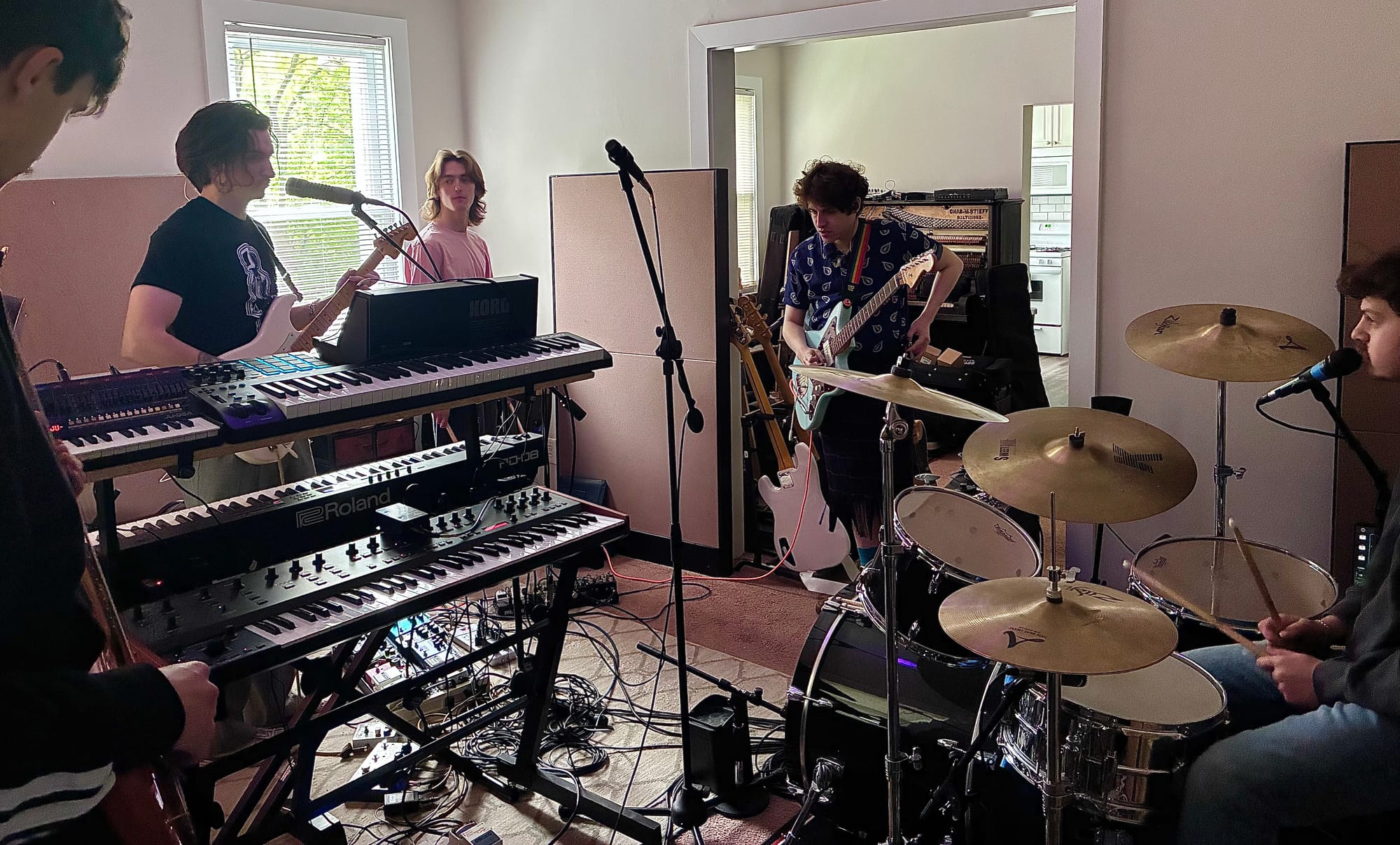
When one steps into the house in Adelphi, Maryland, the first thing they will notice is a shrine-like array of synthesizers and keyboards positioned in the center of the living room, flanked by hand built acoustic paneling against each wall. According to Posse-Mir, the chaotic ecosystem of cords, amps, monitors, and pedal boards are all part of a larger vision.
“Our entire life is here. Everything we own. It's a lot of equipment," said Posse-Mir.
Once the house is finished, each room on the ground floor will be dedicated to recording a different set of instruments. Every room will be connected to a patch bay where an engineer can control the line inputs. “Essentially, I'm going to be able to record any location in the house, from a mix room,” he explained.
The house began early on as a passion project for Posse-Mir and his creative partner Holden Cowburn, who is the drummer, writer and co-producer for their band Mancala.
Both Cowburn and Posse-Mir come from an audio production background. Cowburn completed his Bachelor of Arts degree in music industry and tech at York College of Pennsylvania and works as a live sound engineer at a theater nearby. Posse-Mir completed a two year music production degree at Frederick Community College where he met Cowburn during a recording demo in one of his courses.
They later joined with bassist Aidan Twentey to form their project, Mancala, which independently released their debut album, “We’re Only Getting Older,” earlier in August 2025.
Posse-Mir describes the recording process for the album as less than ideal, which took place in a DIY studio in his mother’s home in Urbana, Maryland.
“I took over the one car garage. I used pool noodles and blankets to insulate the sound. I made a couple acoustic panels out of a ping pong table, and had a few mics, a drum kit and one amp that was decent,” Posse-Mir recalled. “90% of the stuff I got for that studio was either free, on Craigslist or Facebook Marketplace.”
But as their recording became more ambitious, Mancala quickly outgrew their improvised set-up. Cowburn and Posse-Mir agreed that once they had the budget, they would move on to a more permanent space.
Once the two narrowed down possible locations, they began reaching out to friends to gauge interest in a potential studio house. In April, they finally grouped together with four other local musicians each with an independent project of their own.
Cowburn sees the house in Adelphi as an ideal location for its capacity and location. He hopes the cost and proximity to both the University of Maryland and Washington D.C. will prove to be an advantage, describing the arrangement as a great option for their friends in Prince George’s County looking for opportunities to record.
“We're looking to be a good outlet for the music community in the DMV. I feel like we can make it way more comfortable. If they're coming here they’re not worried about blowing a budget,” Cowburn said.
“Our property managers have actually been super helpful too,” Posse-Mir noted. “They were actually the ones who gave us the idea to frame the rooms with two-by-fours for our acoustic panels.”
Cowburn and Posse-Mir believe that the studio house in theory can save two of the most important necessities for recording music: time and money.
“Here we can hone our skills. We've got access to the space 24/7 and we can do what we want, take our time on our art, you know, not have to worry about studio time,” Cowburn said. “Eventually it’s cheaper than booking a studio. We’ve invested tens of thousands of dollars in this, but recording an album with a professional engineer can cost tens of thousands of dollars alone.”
All residents at the house in Adelphi are moved in, but according to Posse-Mir, there is still a lot of work to be completed before the space becomes an operational studio. In the meantime, Cowburn and Posse-Mir said they will be spending the next few months equipping each room and preparing acoustic treatment with help from their roommates. They anticipate the house will be fully functional and recording by early July.